
FTL vs LTL: at how many loading metres does a full truck make sense?
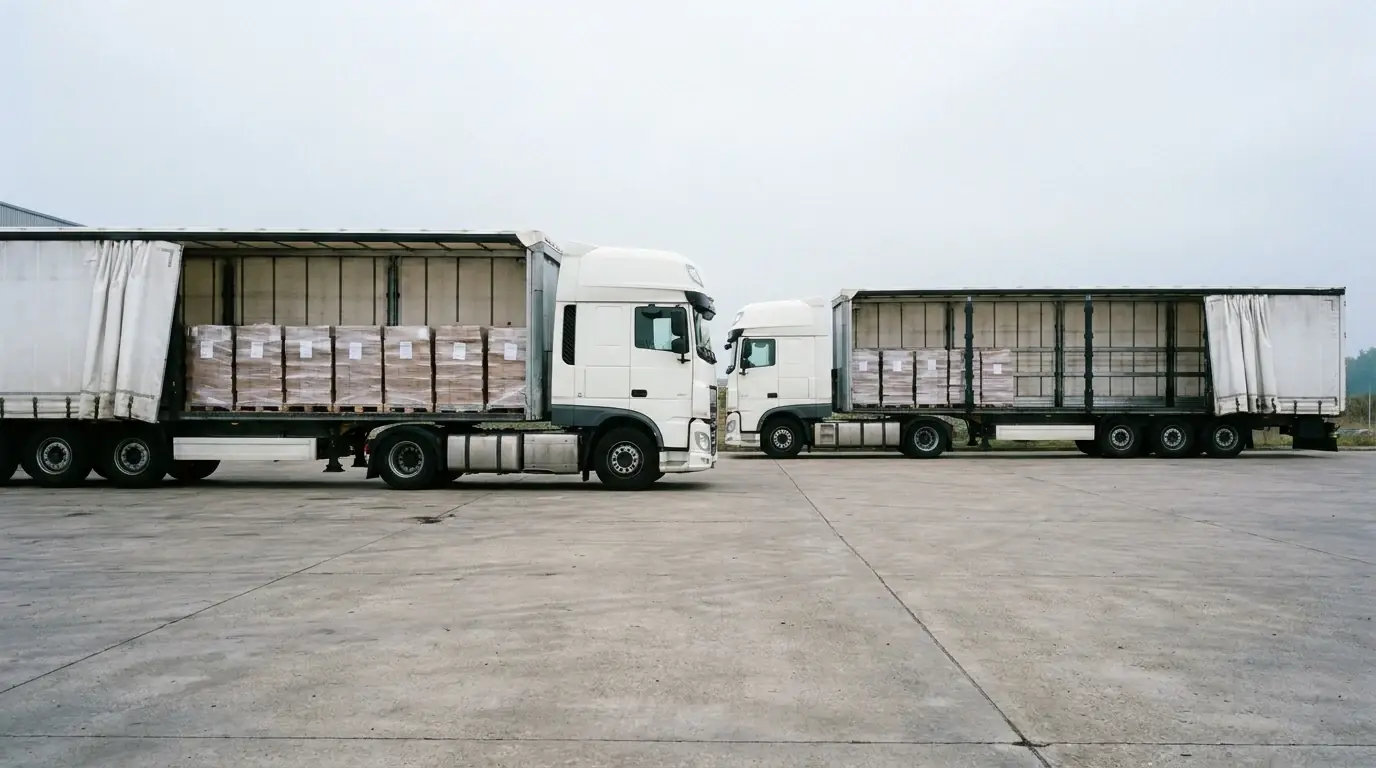
There is no loading-metre figure at which a full truck (FTL) starts to beat groupage (LTL). The full truck wins when the part-load price at your chargeable weight reaches the full-truck price on the same lane, and that point moves with the carrier's kg-per-LDM factor, your cargo weight and the week's rates. What you can fix in advance is the method: work out loading metres (LDM) and weight from your load list, convert them to chargeable weight the way the carrier's terms do, and set the groupage price against a full-truck quote.
What is being compared
Full truck load (FTL) is a vehicle booked for your goods alone, priced per truck for the lane. Part load, LTL and groupage all mean your pallets share the deck with other consignors' goods and you pay for your share. Carriers do not all use these words the same way, so ask what a quote means by them.
Step 1: get LDM, weight and fill from the plan
A groupage carrier prices two numbers, loading metres and kilograms. The planner at ldmcalculator.com/en/truck gives both from one entry, plus the share of floor and volume used. Two example loads: euro pallets 1.20 x 0.80 m, not stackable, 1.10 m high, on a 13.60 x 2.48 x 2.70 m trailer.
| Load | Pallets | Weight per pallet (kg) | Total (kg) | Planner LDM | Floor used (LDM / 13.6) | Volume fill |
|---|---|---|---|---|---|---|
| A | 22 | 350 | 7,700 | 8.8 | 64.7% | 25.5% |
| B | 18 | 1,000 | 18,000 | 7.2 | 52.9% | 20.9% |
Load A is the planner's main part-load layout. Load B is shown in full-truck mode; in part-load mode the planner's main layout runs to 9.4 m (see the last section).
Check on A: 22 x 0.4 = 8.8 m, which the planner reaches by mixing lengthwise rows of three and turned rows of two, and 8.8 / 13.6 = 64.7%. Its alternative layout, all lengthwise three across, needs 8 rows (7 full rows of 3 = 21, plus 1), 8 x 1.2 = 9.6 m. The volume is 22 x 1.2 x 0.8 x 1.1 = 23.232 m³ against 13.6 x 2.48 x 2.7 = 91.07 m³, which is 25.5%. The floor is about two thirds used and the volume a quarter, so for this load the floor is the scarce resource. The pallet table gives LDM per pallet count for other layouts.
Step 2: convert to the weight the carrier charges
Chargeable-weight rules differ by network, so the example uses one published set. Schenker Deutschland's domestic terms (June 2026) say that from 2 Ldm or 2,501 kg the chargeable weight is "das Maximum aus dem Kubikmeter Gewicht, dem Lademeter Gewicht und dem tatsächlichen Gewicht" (the highest of cubic-metre weight, loading-metre weight and actual weight) at "250 kg per cbm und 1.250 kg per Ldm" (Schenker, clause 13, dsv.com ). Replace these factors with the ones in your own offer.
| Load | Actual (kg) | Volume x factor (kg) | LDM x factor (kg) | Chargeable (kg) |
|---|---|---|---|---|
| A, Schenker domestic | 7,700 | 23.232 x 250 = 5,808 | 8.8 x 1,250 = 11,000 | 11,000 |
| B, Schenker domestic | 18,000 | 19.008 x 250 = 4,752 | 7.2 x 1,250 = 9,000 | 18,000 |
Load A is billed on its loading metres: 11,000 kg against a real weight of 7,700 kg, 1.43 times. A carrier that counts whole lengthwise rows would take 9.6 Ldm instead, the planner's alternative layout, and 9.6 x 1,250 = 12,000 kg; ask which rule the offer uses. Load B is billed on its real weight either way (even at 9.4 m it would be 11,750 kg of LDM weight), so its loading metres do not change the price. At 0.4 LDM per pallet and 1,250 kg per LDM, the line between the two cases is 500 kg per pallet.
Step 3: put the two prices side by side
Apply the groupage rate from your offer to the chargeable weight (or to the LDM if the offer is per metre), add the surcharges the offer lists, such as fuel and toll, and compare with the full-truck quote F:
- Per-100 kg offer: groupage = chargeable kg / 100 x rate. For load A at the Schenker figure, 110 x rate.
- Per-LDM offer: groupage = LDM x rate per LDM. For load A, 8.8 x rate.
- The full truck wins when F is below that sum.
A second view needs no groupage price. If you book the whole truck and use N loading metres, each metre costs F / N. Against a deck filled to 13.6 LDM, the empty metres raise the cost per metre like this:
| LDM you use (N) | Cost per LDM relative to a full deck (13.6 / N) |
|---|---|
| 4.8 | 2.83 times |
| 7.2 | 1.89 times |
| 8.8 | 1.55 times |
| 13.2 | 1.03 times |
The full truck is the better buy when the groupage rate per LDM you were offered is above F / N. The table is a ratio, not a price.
What the price leaves out
For international road carriage the CMR Convention (unece.org) covers four things a price comparison ignores. Domestic carriage inside one country is outside CMR (article 1(1)); there national law and the carrier's terms apply.
Transit time
Groupage goes through collection, consolidation and delivery. Article 19 defines delay with that in mind: "in the case of partial loads, the time required for making up a complete load in the normal way" counts when judging what a diligent carrier could do. Ask a groupage forwarder for the departure day as well as the delivery day.
Hand-overs
Under article 8(1) the carrier checks "the apparent condition of the goods and their packaging" when taking over, and under article 35(1) a successive carrier gives a signed receipt and enters reservations. Article 34 makes each carrier responsible for the whole operation only where carriage under a single contract is performed by successive road carriers; whether a groupage chain falls under it depends on the contract. The convention says who answers for damage, not how often damage happens.
Who loaded the truck
Article 17(4)(c) relieves the carrier of liability for damage arising from "handling, loading, stowage or unloading of the goods by the sender, the consignee or person acting on behalf of the sender or the consignee", read with article 18(2), under which the claimant may prove the damage came from elsewhere. If you load the truck yourself, stowage and securing are on your side of that line.
Compensation for delay
Under article 23(5), compensation for damage from delay is limited to an amount "not exceeding the carriage charges", unless a special interest in delivery was declared against a surcharge under article 26(1). A cheap groupage freight therefore also limits what a missed production slot can recover. Article 23(3) sets a separate per-kilogram cap for loss of or damage to the goods; check the amount that applies to your shipment with your carrier or insurer.
A full truck is also loaded differently
The planner has a full-truck mode that spreads the load over the deck and aims for about 40% of the weight on the front 6 m, and a part-load mode that packs from the headboard so the rear stays free for other cargo. These are our planner's rules, not law. Load B with the axle check on:
| Mode | Used deck | Front share | Planner verdict |
|---|---|---|---|
| Part load | 0 to 9.4 m | 52.8% | Not balanced (band 35 to 47%) |
| Full truck | 3.1 to 10.3 m (7.2 m) | 40.3% | Balanced |
On a shared deck heavy pallets cannot be centred, because the metres behind them belong to someone else. In these runs 18 t of cargo ran to 9.4 m of deck in part-load mode and 7.2 m when the planner could place it freely, so heavy, dense goods point to a full truck earlier than the LDM alone suggests. Check the payload on your own vehicle papers before assuming 18 t fits.
What to do with this
Ask for both quotes whenever the chargeable weight comes from loading metres (as with load A) and the load fills several metres of deck. When the actual weight sets the chargeable weight (as with load B), you are paying per kilogram for goods a full truck would carry at one price, so chase the full-truck quote first. Keep the sums in one sheet: LDM, actual kg, chargeable kg per carrier, groupage total, F and F / N. Run the next load through the planner with real pallet weights before you ask for rates, because the weight column decides which case you are in.
Sources
Trade terms change, and each applies to one network.
- UNECE, Convention on the Contract for the International Carriage of Goods by Road (CMR) (unece.org), E/ECE/253, articles 1(1), 8(1), 17(4)(c), 18(2), 19, 23(3), 23(5), 26(1), 34 and 35(1).
- Schenker Deutschland AG, Vertragsbedingungen, Stand: Juni 2026 (dsv.com), clause 13 (National).
- Planner figures: LDM Calculator truck planner, November 2026.